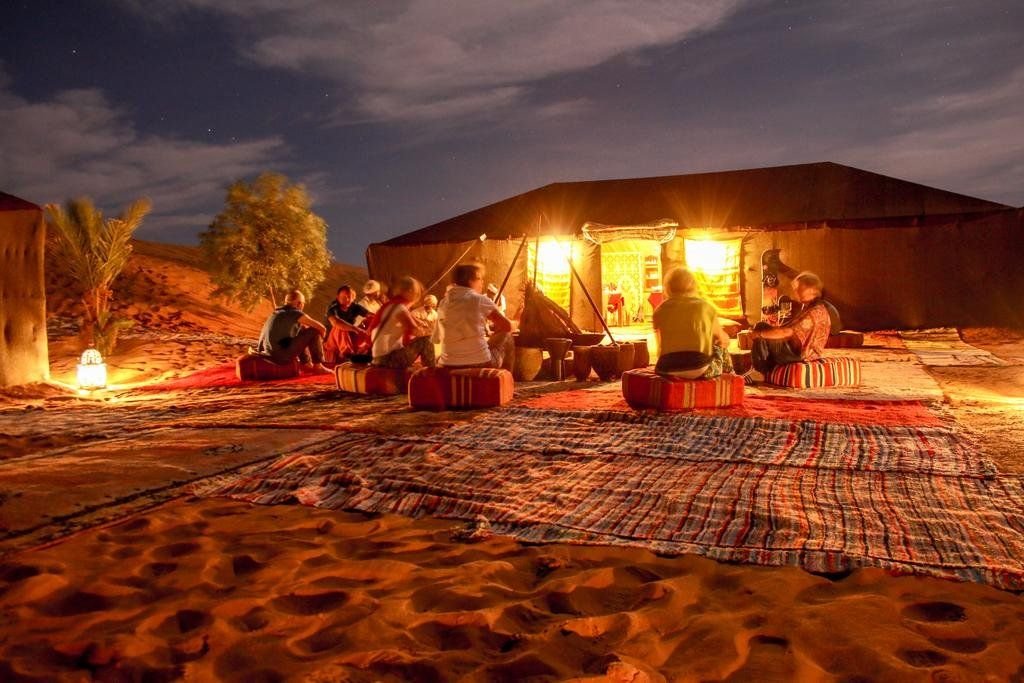
Long before "glamping" had a name, the Berber people — the Amazigh, "free people" — had perfected the art of living beautifully in the desert. Woven wool tents that breathe in the heat. Tea ceremonies that turn three sips into an hour of welcome. Music that needs nothing but drums, hands and a fire. A night at a Berber camp in Morocco isn't a themed experience invented for visitors; it's an invitation into one of North Africa's oldest living cultures, staged in the most dramatic setting it has ever had — the open Sahara.
Here's what that night actually looks like, what the traditions mean, and how to choose a camp where the culture is real rather than a backdrop.
Hospitality as a sacred duty
In Amazigh culture, the guest is not a customer — the guest is a responsibility. Hospitality codes run deep in desert life for a simple reason: in a hard landscape, the welcome you give a traveller is the welcome you hope to receive. That inheritance is why the service at a true Berber camp feels different from a hotel's. Your hosts aren't performing friendliness; they're upholding something. At Sundrift Luxury Camp, most of our team grew up in and around Merzouga, and the difference shows in a hundred small gestures — the blanket that appears before you knew you were cold, the quiet tip about which dune catches the last light.
The tea ceremony: whisky of the desert
Your stay will be measured in glasses of mint tea — green gunpowder tea packed with fresh mint and (traditionally) a frankly heroic amount of sugar. Berbers joke that it's "Berber whisky," and the pouring is the point: the host raises the pot high so the tea falls in a long arc and builds a crown of foam in the glass. Three glasses is customary; an old saying gives each a flavour — the first gentle as life, the second strong as love, the third bitter as death. Accept all three. It's the desert's way of saying you're no longer a stranger.
Tajine, bread and the desert kitchen
Dinner at a Berber camp is slow food in the literal sense. The Tajine — the cone-lidded clay pot and the dish it cooks — simmers for hours over coals: chicken with preserved lemon and olives, lamb with prunes and almonds, vegetables perfumed with saffron and cumin. Bread is baked fresh daily, sometimes in the sand itself under embers, and the meal ends with orange slices dusted in cinnamon or dates from the nearby Tafilalet oasis, one of the great date gardens of the world. Guests regularly tell us the best meal of their Moroccan trip was eaten at a folding table in the dunes.
Music around the bonfire
When the plates are cleared, the fire is lit and the drums come out. Berber rhythms — and in the Merzouga region, the hypnotic Gnawa music of nearby Khamlia village — are call-and-response: clap, sing back, take a turn on the drum, laugh when you lose the beat. No stage or spotlight; the circle is the show. Above it all hangs a sky with no light pollution for miles, so between songs you'll watch satellites drift and meteors burn. It is, reliably, the night guests describe first when they get home.
Tents woven from the landscape
The traditional Berber tent — the khaima — was woven from goat hair and wool, dark-striped, low-slung and ingeniously ventilated. A modern luxury Berber camp keeps the silhouette and the craft (hand-woven rugs, wool blankets, iron lanterns) and adds what the nomads never had: king-sized beds, en-suite bathrooms with hot water, and air conditioning for the summer months. Our Triple Tent sleeps three this way, and the family-sized Quadruple Tent four — the aesthetic is ancestral, the comfort is contemporary.
How to choose an authentic Berber camp
- Local hosts. Ask who runs the camp. Amazigh-run camps carry the culture natively rather than hiring it in.
- Real dunes. A Berber camp at Erg Chebbi puts you inside the sand sea, not beside a stony plain an hour from it.
- Small scale. A camp with a handful of tents keeps the fire circle intimate; a hundred-tent village cannot.
- Music by the family, not a booked act. The difference is audible.
- Comfort where it counts. Tradition in the textiles, modern plumbing in the bathroom. You want both.
When to experience it
October to April brings warm days and crisp, star-heavy nights — perfect bonfire weather. Summer works too if your tent has A/C for the afternoon heat; the evenings remain magical year-round. However you time it, one Berber camp night tends to reorganise a Morocco itinerary's highlights list — usually to the top. Ready to take your seat by the fire? Tell us your dates and we'll keep a glass of mint tea waiting.